Whispers of Stone: Ayutthaya’s Forgotten Art Speaks Through Ruins
Have you ever walked through ruins that feel alive? In Ayutthaya, Thailand, ancient temples rise from the earth like silent sculptures, each stone whispering stories of a lost empire. I never expected crumbling walls to move me so deeply, but here, architecture isn’t just structure—it’s soul. The interplay of shadow and silhouette, the rhythm of broken spires against the sky—it’s art carved in time. This is not just history. It’s a visual poem. More than 600 years after its founding and nearly three centuries since its fall, Ayutthaya continues to speak—not in words, but in form, light, and silence. Its ruins are not endings, but echoes shaped by time, faith, and nature’s quiet hand.
The First Glimpse: Arriving in Ayutthaya with No Expectations
Approaching Ayutthaya from Bangkok, the transition is subtle. The urban sprawl gradually gives way to rice fields, waterways, and scattered temple mounds rising like ancient sentinels from the flat Chao Phraya floodplain. There is no grand announcement, no towering skyline—just a quiet emergence of history beneath the tropical sun. For first-time visitors, this understated arrival enhances the sense of discovery. Ayutthaya does not impose itself; it reveals itself slowly, like a manuscript unrolled over centuries.
Established in 1350, Ayutthaya was once the capital of Siam and one of the largest cities in the world. At its peak, it housed nearly a million people and served as a hub of trade, diplomacy, and religious scholarship. Today, the Ayutthaya Historical Park, designated a UNESCO World Heritage Site in 1991, preserves over 20 major ruins and countless smaller remnants across 289 hectares. But what sets this site apart is not merely its scale or historical significance—it is the aesthetic depth embedded in every archway, staircase, and broken spire.
Unlike many ancient capitals reduced to archaeological footprints, Ayutthaya’s ruins retain a profound visual presence. The city was not built for utility alone. Its temples were designed as metaphors—symbols of cosmic order, spiritual ascent, and divine protection. Even in ruin, they communicate. The symmetry of their layouts, the elegance of their proportions, and the deliberate placement within the riverine landscape suggest an artistic vision that transcended mere construction. To walk through Ayutthaya is not just to witness history, but to experience a form of sacred artistry that continues to resonate.
A Fusion Forged in Fire and Faith: Understanding Ayutthaya’s Architectural DNA
The architecture of Ayutthaya reflects a remarkable synthesis of cultural and religious influences. As a successor to the Sukhothai Kingdom and a contemporary of the Khmer Empire, Ayutthaya absorbed and reinterpreted architectural traditions from across Southeast Asia. The result was a distinct design language—one that balanced grandeur with refinement, symbolism with functionality. At the heart of this fusion were three dominant styles: Khmer, Sukhothai, and early Thai Buddhist, each contributing unique elements to the city’s spiritual skyline.
One of the most striking features of Ayutthaya’s temples is the prang—a tall, corn-cob-shaped tower derived from Khmer temple architecture, most famously seen at Angkor Wat. These vertical structures were not merely decorative; they symbolized Mount Meru, the sacred center of the Buddhist and Hindu cosmos. Temples like Wat Phra Si Sanphet, the royal monastery located within the former palace grounds, feature a row of three central prangs that rise in graduated height, creating a rhythmic silhouette against the sky. The use of brick and stucco allowed for intricate detailing, including lotus motifs, celestial beings, and flame-like crests that gave the towers a sense of upward motion.
In contrast, the chedi—bell-shaped stupas more closely associated with Theravada Buddhism—reflect the influence of the Sukhothai period. These rounded forms, often covered in white plaster, represent the Buddha’s enlightenment and the purity of the Dhamma. At Wat Ratchaburana, the central prang stands above an underground crypt filled with restored murals and Buddha images, blending Khmer structural boldness with Thai spiritual subtlety. Similarly, the viharn, or assembly hall, evolved into a space of both communal worship and artistic expression, with high gabled roofs, wooden doors carved with mythological scenes, and interior walls once adorned with vibrant murals.
The layout of temple complexes followed cosmological principles. Most were oriented east-west, aligning with the path of the sun, and arranged in concentric zones—outer courtyards for laypeople, inner enclosures for monks, and the most sacred areas reserved for relics and altars. This spatial hierarchy mirrored the Buddhist understanding of the universe: from the mundane to the enlightened, from the earthly to the divine. Every architectural choice, from the height of a spire to the width of a gallery, was made with symbolic intent. Ayutthaya was not just a city of temples—it was a city as temple.
Nature Reclaims the Canvas: How Time Became an Artist
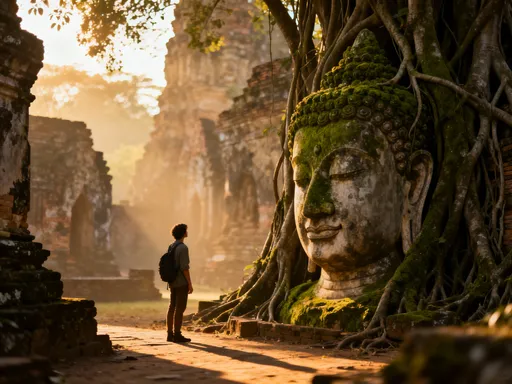
If Ayutthaya’s builders were the original artists, then time and nature have become its most poetic collaborators. Centuries of monsoon rains, shifting riverbanks, and tropical vegetation have transformed the ruins into something even more profound than their creators might have imagined. Where once there were polished spires and gilded roofs, now there are roots entwining stone, trees growing from within temple cores, and moss softening the edges of carved deities. This is not decay in the conventional sense—it is metamorphosis.
The most iconic image of Ayutthaya, the Buddha head encased in the roots of a banyan tree at Wat Mahathat, is a perfect example of this organic dialogue. The head, once part of a seated Buddha statue, likely broke off during the Burmese invasion of 1767. Over time, a fig tree seed took root in the stone platform, its roots weaving around the stone face like fingers cradling a memory. Today, this image is reproduced on postcards, textiles, and travel guides—not as a symbol of loss, but as a testament to endurance and transformation. The tree did not destroy the Buddha; it embraced it, turning destruction into a new form of reverence.
This interplay between architecture and nature is visible throughout the park. At Wat Phra Ram, a massive tree grows from the center of a collapsed prang, its branches stretching skyward as if continuing the tower’s original aspiration. Vines drape over broken cloisters, and ferns sprout from cracks in laterite walls. Even the waterways—once used for transport and defense—now reflect the ruins like liquid mirrors, doubling their presence and softening their lines. These natural interventions do not diminish the artistry of the original structures; they enhance it, adding layers of meaning and beauty that evolve with each season.
Artists and photographers are drawn to Ayutthaya not despite its ruinous state, but because of it. The contrast between rigid geometry and organic growth creates endless visual compositions. A single shaft of sunlight piercing through a collapsed roof, illuminating a fragment of stucco; the way shadows stretch across a courtyard at dawn, outlining the ghost of a lost wall—these moments feel curated, as if time itself is composing a slow-moving exhibition. In this sense, Ayutthaya is not frozen in the past. It is still creating.
Beyond the Postcard: Hidden Details That Tell the Real Story
While the grand silhouettes of prangs and the famous Buddha-in-roots capture the imagination, the true artistry of Ayutthaya lies in the details—those subtle, often overlooked elements that reveal the craftsmanship and spiritual intent behind every structure. These are not mere decorations; they are narratives carved in stone, expressions of a worldview where beauty and meaning were inseparable.
Look closely at the lintels above temple doorways, and you may find intricate carvings of devas (celestial beings), garudas (mythical bird-like creatures), or scenes from the Jataka tales—the stories of the Buddha’s past lives. These were not just ornamental; they served as visual teachings, guiding worshippers from the profane to the sacred as they entered the viharn. The use of relief carving, where figures emerge slightly from the stone surface, creates a sense of depth and movement, especially when lit by flickering candlelight during ceremonies.
Another recurring motif is the lotus bud finial—a slender, tapering spire that crowns many chedis and prangs. The lotus, which grows from muddy water yet blooms in perfect purity, is a central symbol in Buddhism, representing enlightenment and spiritual rebirth. By placing this form at the highest point of a temple, architects emphasized the journey from ignorance to awakening. Similarly, the use of stucco in floral and flame patterns around window frames and arches adds a sense of rhythm and flow, softening the rigidity of stone and brick.
Even the materials themselves tell a story. Laterite, a porous reddish stone, was used for temple foundations and outer walls because of its durability and availability. Finer details, such as Buddha images and decorative elements, were often made from stucco or carved from sandstone, then covered in gold leaf or paint. Traces of these finishes can still be seen at Wat Phra Si Sanphet, where fragments of red, green, and gold pigments cling to surviving stucco work. These remnants remind us that Ayutthaya was once a city of dazzling color, not the muted gray and brown we see today.
To appreciate these details requires a shift in pace. Most tourists follow a checklist: Wat Mahathat, Wat Phra Si Sanphet, Wat Chaiwatthanaram. But the real art of Ayutthaya is found in slowing down—kneeling to examine a weathered carving, tracing the curve of a broken balustrade, or noticing how light filters through a lattice window. It is in these quiet moments that the temples cease to be ruins and become living galleries.
Light, Shadow, and the Rhythm of Ruins
One of the most powerful aspects of Ayutthaya’s artistry is its relationship with light. Unlike enclosed museums or indoor galleries, Ayutthaya is an open-air exhibition where the quality of light changes with the hour, the season, and the weather. This dynamic interplay transforms the experience of the site from a static observation into a sensory journey.
Dawn is perhaps the most magical time to visit. As the sun rises over the Chao Phraya River, a soft golden light spills across the ruins, casting long, dramatic shadows that emphasize the verticality of the prangs and the symmetry of the courtyards. Mist often lingers in the low-lying areas, wrapping the bases of temples in a silvery haze, making them appear to float above the earth. This ethereal quality enhances the spiritual aura of the site, blurring the line between the physical and the metaphysical.
By midday, the light becomes harsher, revealing every crack, crevice, and texture in sharp relief. While less romantic, this clarity allows for a closer study of craftsmanship—the precision of stone joints, the depth of carvings, the wear patterns on staircases polished by centuries of footsteps. Late afternoon brings a return of warmth, with the sun casting amber tones across the laterite walls and illuminating the interiors of partially roofed structures. At this hour, the ruins seem to glow from within, as if still holding the memory of their original splendor.
The layout of the temples also contributes to a rhythmic experience of movement and revelation. Pathways are not random; they are designed to guide visitors through a sequence of spaces—open courtyards, shaded galleries, intimate chapels—each offering a different perspective. At Wat Chaiwatthanaram, a Khmer-style temple on the west bank of the river, the central prang is approached through a series of concentric terraces, each level higher than the last, creating a sense of ascent that mirrors the spiritual journey toward enlightenment. Every turn offers a new composition: a framed view of a distant stupa, a silhouette against the sky, a reflection in a puddle left by the morning rain.
For photographers, painters, and contemplative travelers alike, Ayutthaya functions as a natural stage for visual storytelling. There are no artificial spotlights or curated displays—just the interplay of form, light, and time. To walk through the ruins is to participate in an unscripted performance, where each visitor becomes both audience and co-creator of the experience.
Why This Art Still Matters: Ayutthaya as a Living Influence
The legacy of Ayutthaya extends far beyond its archaeological boundaries. Its architectural language continues to shape contemporary Thai design, from modern temples in Bangkok to government buildings, hotels, and even private homes. The prang, once a symbol of royal and religious power, now appears in stylized forms on public monuments and cultural centers. The lotus motif is ubiquitous in Thai art, appearing in textiles, ceramics, and jewelry. Even urban planning in Thailand often reflects the Ayutthayan principle of hierarchical space—separating public, semi-private, and sacred zones.
Restoration efforts at Ayutthaya itself demonstrate a deep respect for this living tradition. Rather than rebuilding temples to their former glory, conservators follow UNESCO guidelines that prioritize authenticity and minimal intervention. The goal is not to erase the marks of time, but to stabilize the structures while preserving their historical and aesthetic integrity. At Wat Phra Si Sanphet, for example, only the lower sections of the prangs have been restored, leaving the upper portions in their ruined state. This approach acknowledges that the passage of time is part of the site’s story—it is not something to be corrected, but honored.
Local artists also draw inspiration from Ayutthaya’s ruins. Sculptors recreate ancient motifs in modern materials, blending traditional forms with contemporary expression. Painters capture the interplay of light and decay in large-scale canvases, while ceramicists imprint lotus patterns and celestial beings onto functional ware. Some installations even use fallen bricks from the site—collected legally and ethically—to create new artworks that bridge past and present.
For Thai people, Ayutthaya is more than a tourist destination; it is a source of cultural pride and spiritual continuity. Annual festivals, such as Loy Krathong and Visakha Bucha, are celebrated at the temples with candlelit processions, flower offerings, and chanting. These rituals do not treat the ruins as relics of a dead civilization, but as active spaces of devotion and memory. In this way, Ayutthaya remains a living site—not frozen in time, but evolving through it.
How to Experience the Art, Not Just the Site
To truly appreciate Ayutthaya’s artistry, one must move beyond the checklist mentality and embrace a more mindful, immersive approach. The most rewarding visits are not the fastest, but the most attentive. Timing, pace, and perspective all play a role in shaping the experience.
The best times to visit are early morning or late afternoon, when the light is most forgiving and the temperatures are cooler. Midday heat can be intense, especially during the dry season from November to February, so planning around sunrise or sunset not only enhances visual clarity but also comfort. Many visitors rent bicycles—a traditional and sustainable way to navigate the island’s flat terrain. Cycling allows for spontaneity, letting you stop at lesser-known ruins like Wat Kudi Dao or Wat Thammikarat, where overgrown paths and quiet courtyards offer a more intimate encounter with the site.
While the major temples are essential, they should not dominate the itinerary. Balancing them with quieter locations provides contrast and depth. Wat Chaiwatthanaram, though more remote, offers a dramatic riverside setting and a sense of solitude unmatched by the busier central ruins. Similarly, Wat Ratchaburana rewards close inspection with its well-preserved crypt and delicate stucco work. Even the spaces between temples—the tree-lined avenues, the water channels, the occasional glimpse of local life—contribute to the overall atmosphere.
Photographers should come prepared with wide-angle and macro lenses to capture both grand vistas and intricate details. But beyond the camera, visitors are encouraged to pause—sit on a shaded step, close their eyes, and listen. The rustle of leaves, the call of temple bells, the distant hum of a passing boat—these sounds are part of Ayutthaya’s living symphony. Mindfulness transforms the visit from observation to participation.
Guided tours can be helpful, especially those led by local historians or art scholars who can explain symbolism and context. However, solo exploration also has its rewards, allowing for personal interpretation and quiet reflection. Whether alone or with a group, the key is to move slowly, look closely, and remain open to the subtle ways in which the ruins communicate.
Conclusion: When Stones Sing
Ayutthaya is not a city of the dead. It is a city of whispers—of stones that speak through form, light, and silence. Its ruins are not endings, but continuations: a dialogue between past and present, between human creation and natural transformation, between loss and beauty. To walk through Ayutthaya is to witness a masterpiece still in progress, shaped by centuries of wind, water, and memory.
This is not just history preserved. This is art sustained by time. The broken spires, the encircling roots, the faded pigments—they are not signs of decline, but evidence of resilience. They remind us that beauty does not require perfection, and meaning does not depend on completeness. Sometimes, the most powerful expressions emerge from what remains.
For the traveler seeking more than a destination, Ayutthaya offers a rare gift: the chance to listen. To slow down, to look deeply, and to feel the presence of something greater than oneself. In a world that often values the new, the fast, the flawless, Ayutthaya stands as a quiet counterpoint—a testament to the enduring power of art, faith, and the human spirit. The stones may be old, but their song is timeless.